What an Application Identifier is
A GS1 Application Identifier is a two to four digit prefix that says what the data after it means. 01 means a GTIN, 10 means a batch or lot number, 17 means an expiry date. Retail barcodes have carried them for decades; a digital link carries the same identifiers inside a web address, so a register and a phone read one symbol.
https://gs1-acme.kuikco.de/01/09506000134352/10/LOT42/21/SER9?17=271231&3102=001250

HRI  (01)09506000134352(10)LOT42(21)SER9(17)271231(3102)001250
The table below lists every identifier KuikCode knows by name. It is rendered from the validation table inside the product, so a format here is a format the editor enforces and the resolver parses. The authoritative definitions are GS1's own: the GS1 Application Identifier list and the GS1 General Specifications.
The identifiers
| AI | Name | Travels as | Format | Example | In the editor |
|---|---|---|---|---|---|
| 01 | GTIN | Primary key, in the path | Exactly 14 digits | (01)09506000134352GTIN-14 | GTIN field |
| 22 | Consumer product variant | Qualifier, in the path | Up to 20 characters, GS1 character set 82 | (22)RED-XLAs written | Own field |
| 10 | Batch or lot number | Qualifier, in the path | Up to 20 characters, GS1 character set 82 | (10)LOT42As written | Own field |
| 21 | Serial number | Qualifier, in the path | Up to 20 characters, GS1 character set 82 | (21)SER9As written | Own field |
| 11 | Production date | Attribute, in the query | Date, YYMMDD, 6 digits | (11)27123131 December 2027 | Attribute dropdown |
| 13 | Packaging date | Attribute, in the query | Date, YYMMDD, 6 digits | (13)27123131 December 2027 | Attribute dropdown |
| 15 | Best before date | Attribute, in the query | Date, YYMMDD, 6 digits | (15)27123131 December 2027 | Attribute dropdown |
| 16 | Sell by date | Attribute, in the query | Date, YYMMDD, 6 digits | (16)27123131 December 2027 | Attribute dropdown |
| 17 | Expiration date | Attribute, in the query | Date, YYMMDD, 6 digits | (17)27123131 December 2027 | Attribute dropdown |
| 30 | Count of items | Attribute, in the query | Up to 8 digits | (30)1212 items | Attribute dropdown |
| 3100 | Net weight (kg) | Attribute, in the query | 6 digits, 0 implied decimals | (3100)0012501250 kg | Custom AI row |
| 3101 | Net weight (kg, 1 decimal) | Attribute, in the query | 6 digits, 1 implied decimal | (3101)001250125.0 kg | Custom AI row |
| 3102 | Net weight (kg, 2 decimals) | Attribute, in the query | 6 digits, 2 implied decimals | (3102)00125012.50 kg | Attribute dropdown |
| 422 | Country of origin | Attribute, in the query | Country, ISO 3166 numeric, 3 digits | (422)840United States | Attribute dropdown |
| 710 | National healthcare reimbursement number | Attribute, in the query | Up to 20 characters, GS1 character set 82 | (710)A123456789As written | Custom AI row |
Anything not listed can still be added as a custom AI. See the rules below.
Where each identifier travels
The Digital Link standard splits identifiers into two places. The primary key and its qualifiers form the path, in a fixed order: 01, then 22, then 10, then 21. A link may skip qualifiers it does not need, but it may not reorder them. Every other identifier is a query parameter, keyed by its AI, in any order.
/01/09506000134352            primary key
/01/…/22/RED-XL               + consumer product variant
/01/…/10/LOT42                + batch or lot
/01/…/21/SER9                 + serial
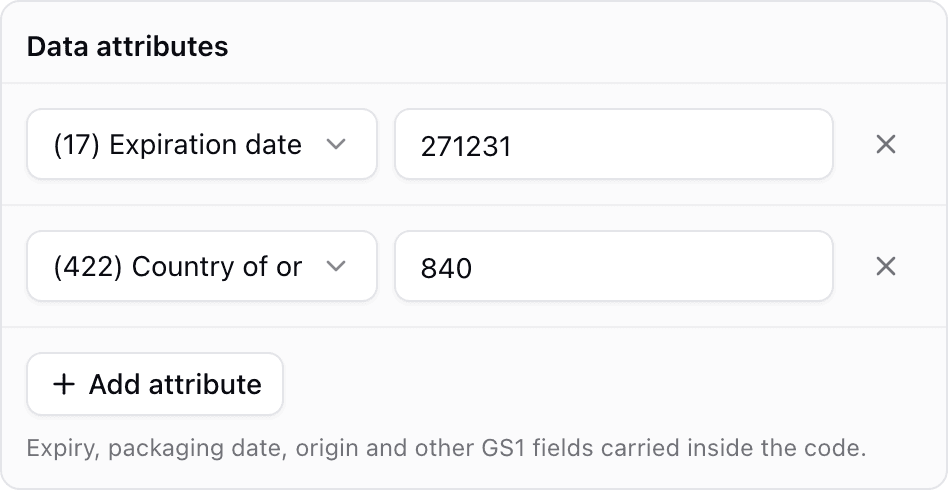
?17=271231&3102=001250        attributes
The human-readable line puts every identifier in brackets in the same order, path first, then attributes. It never shows the web address.
Dates
All GS1 dates are six digits, YYMMDD. 271231 is 31 December 2027. The year is read relative to the current date, so the two-digit form is unambiguous within a 100-year window. GS1 allows 00 as the day on several date identifiers to mean the last day of that month, which is how many expiry dates are printed. KuikCode's editor checks the six digits as you type, month and day included, on named and custom rows alike.
Weights and implied decimals
Measures such as net weight are always six digits, and the last digit of the identifier says where the decimal point goes. 3100 is whole kilograms, 3101 has one decimal, 3102 has two. The value 001250 therefore means 1250 kg under 3100, 125.0 kg under 3101 and 12.50 kg under 3102. The editor's curated dropdown offers 3102 because two decimals suit most consumer packaging.
Custom identifiers
The GS1 General Specifications define far more identifiers than any editor should list. KuikCode accepts any 2 to 4 digit AI as a custom row and applies the general rules: the value uses GS1 character set 82, which is letters, digits and a fixed set of punctuation, and it stays within 90 characters. The identifier's own format rules, such as a fixed length, are yours to follow from GS1's Application Identifier list.
Identifiers that carry an implied decimal or a unit, or that require a fixed length, are worth adding to the named table so the editor can validate them. Tell us which ones your packaging needs.
Questions, answered
01Can I use an AI that is not in this table?+
Yes. Any 2 to 4 digit Application Identifier can be added as a custom row. KuikCode checks that the value uses GS1's allowed character set and stays within 90 characters, and passes it through to the link and the HRI line. The format rules for that AI in the GS1 General Specifications are yours to follow.
02Why do dates have only two digits for the year?+
That is the GS1 format: YYMMDD. Scanners and trading partners read 271231 as 31 December 2027. GS1 also allows 00 as the day to mean the end of the month, which is common on expiry dates. The editor checks the six digits as you type.
03Why must lot come before serial in the path?+
The Digital Link standard fixes the order of the path qualifiers: variant (22), then lot (10), then serial (21). A resolver may reject a link with the qualifiers in another order. KuikCode always writes them in the mandated sequence, whichever order you fill them in.
04Where does a weight like 3102 get its decimal point?+
From the last digit of the AI. 3100 has no decimals, 3101 has one, 3102 has two, so 001250 under 3102 means 12.50 kilograms. The value is always six digits, and the meaning line in the table shows the result.