What a GS1 Digital Link is
A GS1 Digital Link is a web address that carries barcode data, defined by GS1's Digital Link standard. The GTIN your product already has goes into the path, optional details such as a batch number or serial follow it, and dates or weights ride along as query parameters. Encode that address in a QR code and one symbol serves two readers at once.
https://gs1-acme.kuikco.de/01/09506000134352/10/LOT42?17=271231

01  GTIN                 09506000134352
10  Batch or lot         LOT42
17  Expiration date      2027-12-31
The numbers in brackets are GS1 Application Identifiers, the same ones used inside every retail barcode today. A register that supports 2D codes reads the GTIN out of the path and rings the item up. A phone opens the address, and the resolver behind it decides what the shopper sees.
- Primary key
- Always first. A register reads only this.
- Path qualifiers
- Variant, lot, serial, in that fixed order.
- Query attributes
- Dates, weights, origin, any other AI.
One code, two scanners
This is the part that changes packaging. Today a pack carries a linear barcode for the register and, often, a separate QR code for marketing. A digital link folds both into one symbol. The register never follows the link, it only needs the GTIN. The phone never sees the GTIN, it only follows the link. Each reader takes the half it understands.
Because the destination lives behind the resolver rather than inside the code, the page a shopper lands on can change for as long as the product is on shelves. Recall notices, seasonal campaigns, a new instructions page, a per-country variant: none of it needs a reprint.
Retail register
Finds the GTIN in the path and rings the item up. No internet needed.
01 09506000134352
Shopper's phone
Opens the address. Your resolver sends it to today's destination.
KuikPage · link · PDF · rules
What KuikCode builds for you
Turn on GS1 Digital Link in the editor, enter the GTIN, and the code updates as you type. Everything below is part of that one destination type.
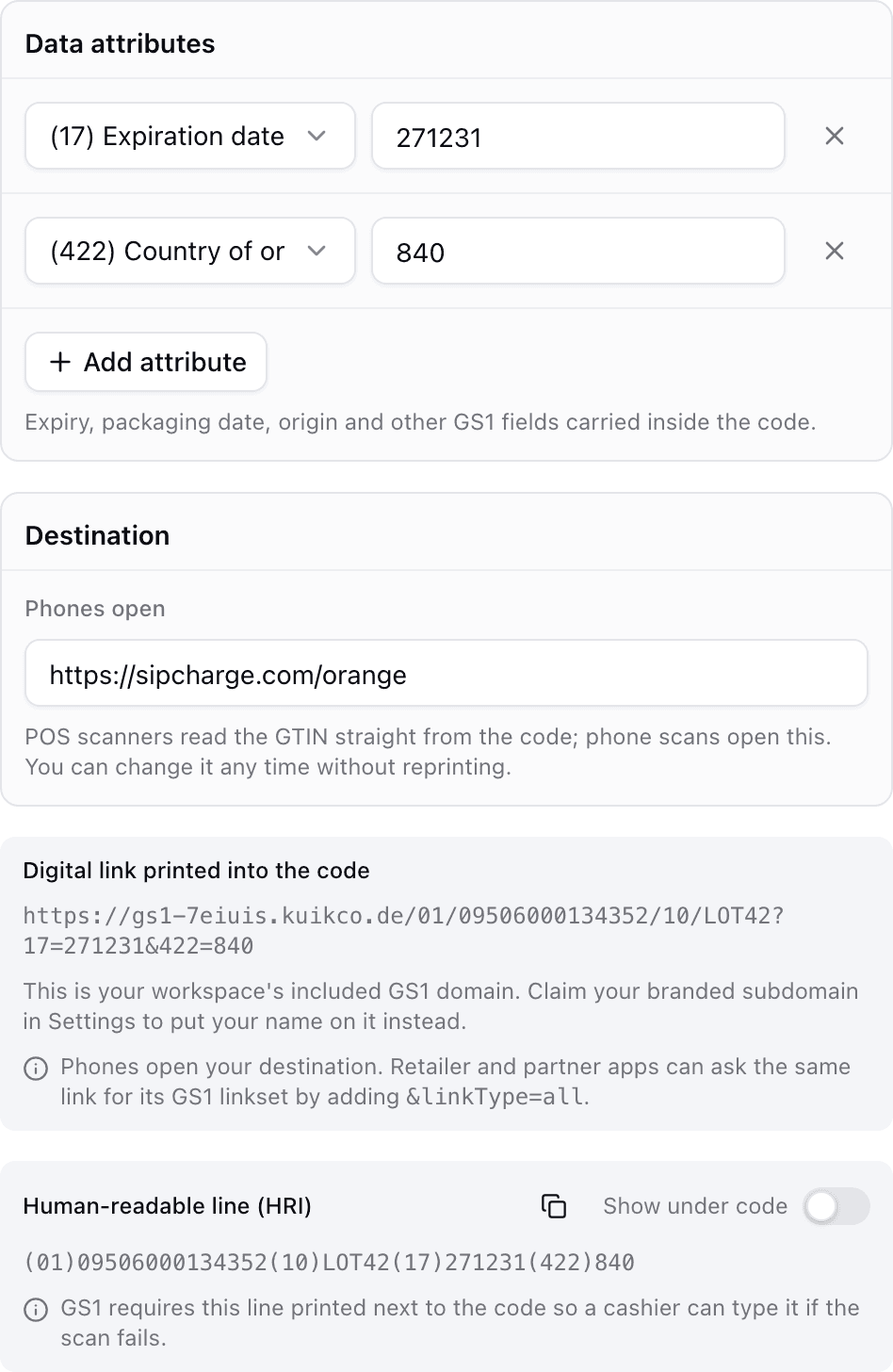
- GTIN validated as you type
- GTIN-8, 12, 13 and 14 with the check digit verified live, normalised to the 14-digit form the standard expects.
- Batch, serial and variant
- Lot (10), serial (21) and consumer product variant (22) in the order the standard mandates, each one optional.
- Application Identifier attributes
- Expiry, packaging, best-before and sell-by dates, country of origin, net weight, item count, and any custom AI you need, each checked against its GS1 format as you type.
- Human-readable line, on by default
- The (01)09506000134352 line GS1 requires next to the symbol prints under the code as part of its frame, so a cashier can key it in if the scan fails.
- Your own host
- An included GS1 host on kuikco.de from the first code, or your branded subdomain and custom domain. The GTIN is unique inside your workspace, never shared with strangers on a common domain.
- Editable phone destination
- A link, a KuikPage you build here, a PDF, or smart rules by country, language, device and time. Change it after printing. The register never notices.
- Bulk from a CSV
- One row per product with GTIN, qualifiers and attribute columns. Every row is validated, duplicates are caught before anything is created, and the whole batch shares one design.
- EAN-13 and Data Matrix companions
- Download the linear barcode and the GS1 Data Matrix of the same GTIN beside the QR, for the panels and labels that still need them.
- Analytics and webhooks
- Every phone scan lands in realtime analytics with city, device and language, and can be forwarded to your systems through scan webhooks.
GS1 Digital Link QR
Phones and 2D registers. The one that carries your brand.
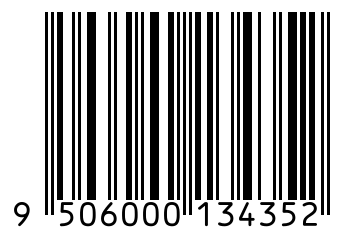
EAN-13
The same GTIN as a linear barcode, for lanes that still read 1D.
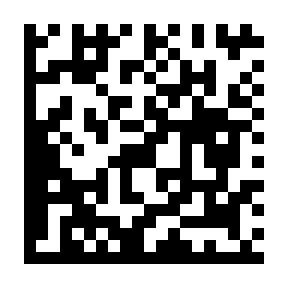
GS1 Data Matrix
Element strings for regulated labelling and supply chain marks.
No product website? Open a KuikPage
Plenty of brands have their GTINs before they have a page for every product. A GS1 KuikCode does not need one. Set phones to open a KuikPage and the code lands on a mobile product page you build from a template in the same workspace: specs or ingredients, variants, how to use it and where to buy, in your colors and fonts.
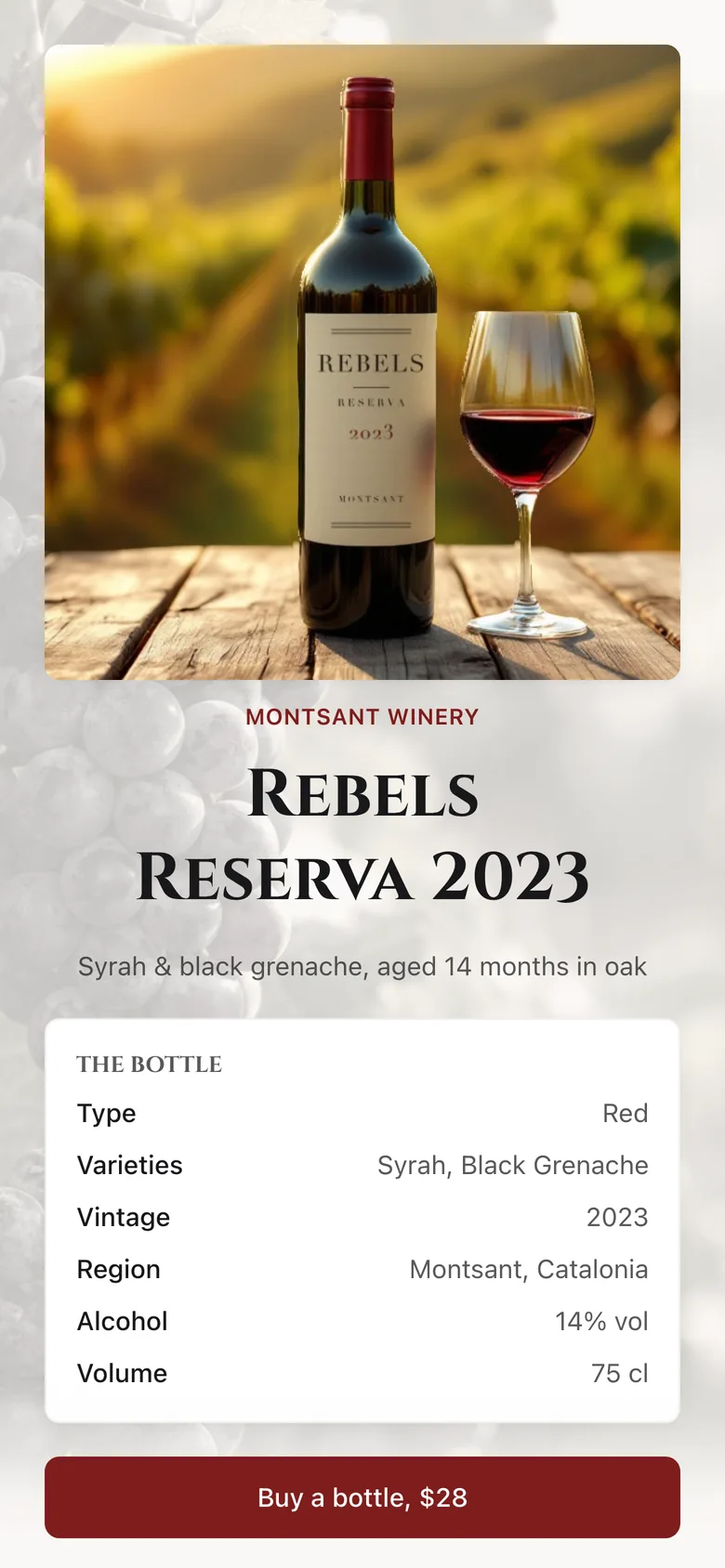
Wine
Specs, tasting notes and a Buy button.
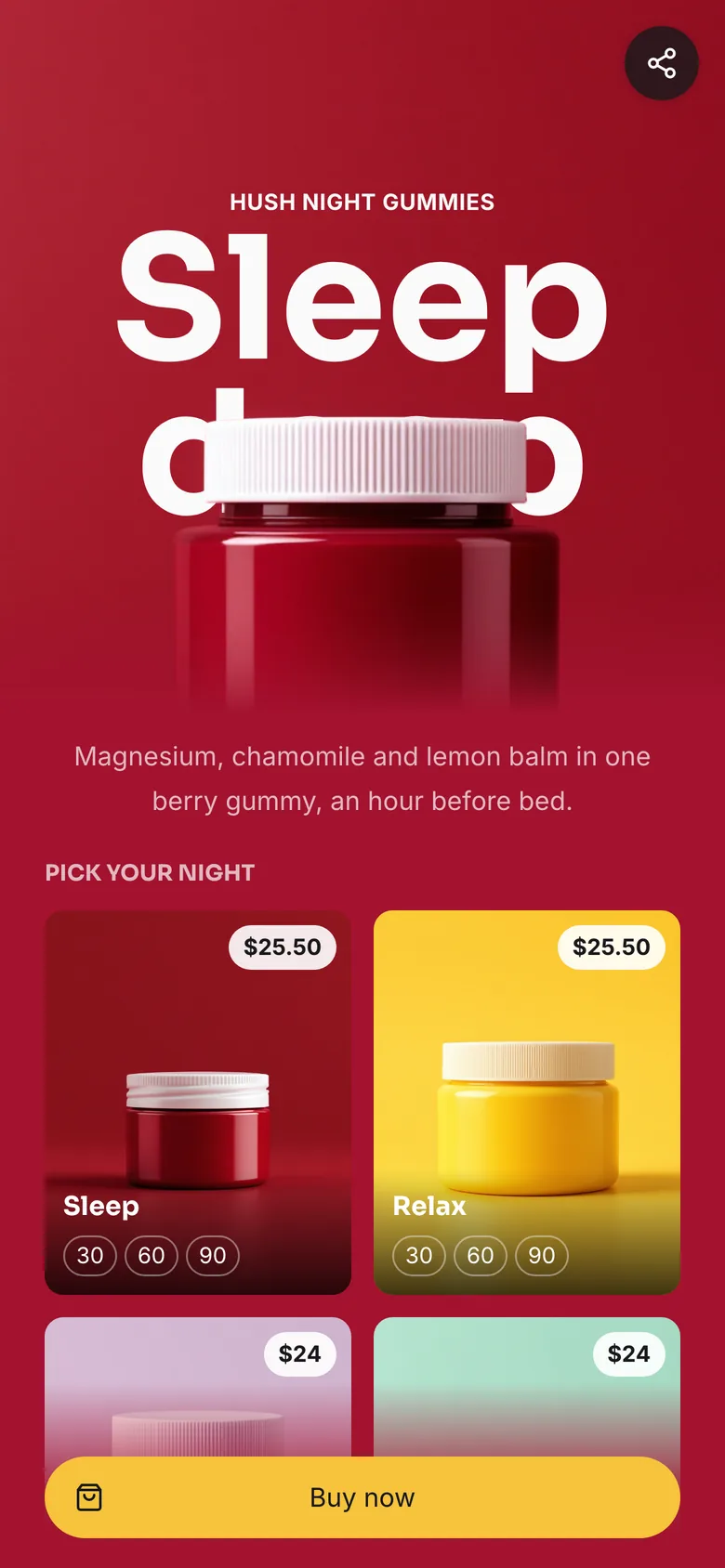
Supplements
Six flavors, each with its own sheet.
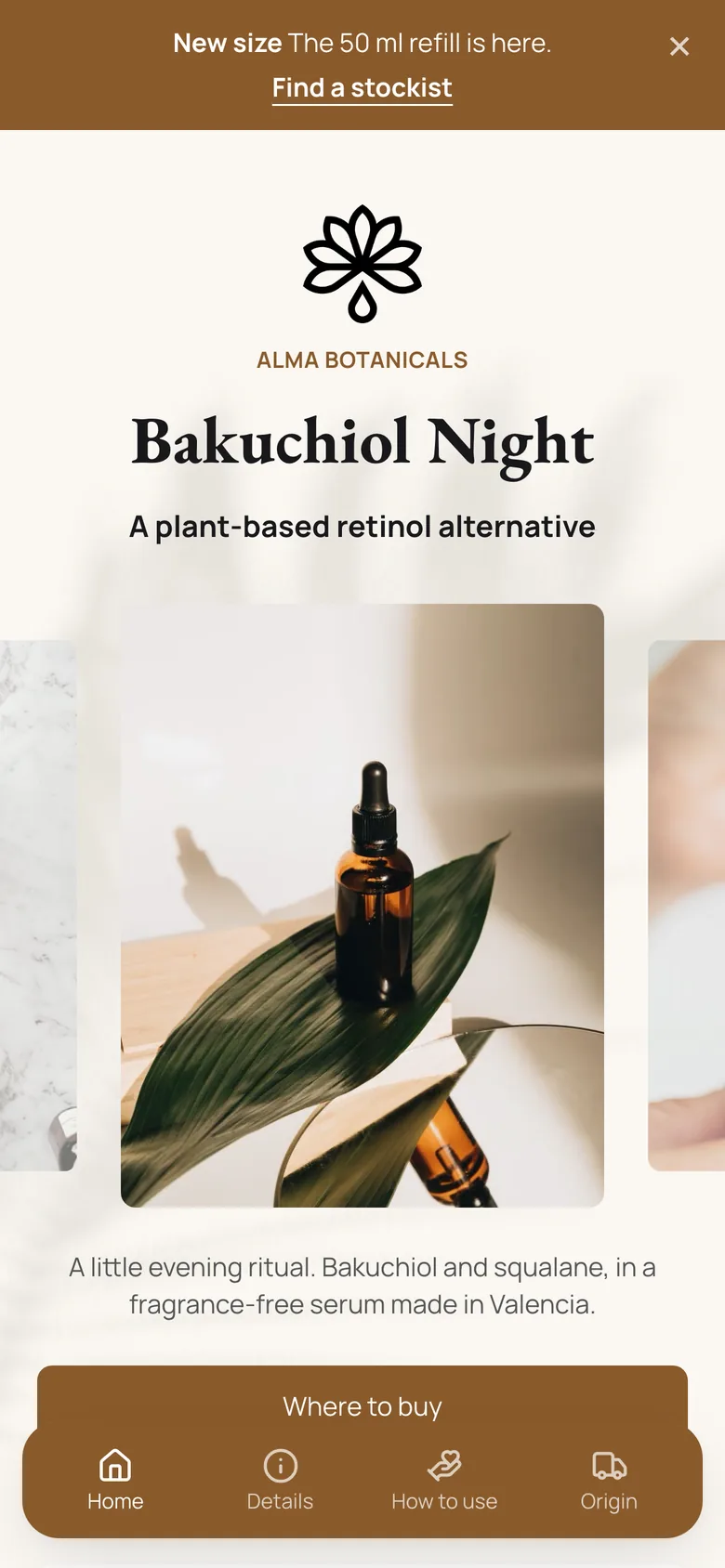
Skincare
Details, how to use it and where to buy.

Ceramics
The collection, the process and a visit.
The page lives on kuik.page or on your own domain and changes whenever you like, without a reprint. When the product gets its own website, point the code there instead. Each page counts its own views, clicks and leads next to the scans of the code.
A resolver that answers, not just redirects
A digital link is only as useful as the resolver behind it. Retailer apps, marketplaces and partner systems do not want a redirect, they want to ask a product what links it offers. KuikCode's resolver answers in the standard way on every host you own.
GET https://gs1-acme.kuikco.de/01/09506000134352?linkType=all
Accept: application/linkset+json

{
  "linkset": [
    {
      "anchor": "https://gs1-acme.kuikco.de/01/09506000134352",
      "https://gs1.org/voc/defaultLink": [
        { "href": "https://acme.com/products/lemonade", "title": "Default link" }
      ],
      "https://gs1.org/voc/pip": [
        { "href": "https://acme.com/products/lemonade", "title": "Product information" }
      ]
    }
  ]
}
Every redirect carries a Link header listing the same typed links, and each host publishes its resolver description at /.well-known/gs1resolver. Those responses are public, so a buyer or a compliance team can verify them without an account. Machine requests for the linkset are never counted as scans, so your analytics keep measuring people.
Sunrise 2027, without the panic
GS1's Sunrise 2027 programme asks retailers to be able to read 2D barcodes at the point of sale by the end of 2027. It does not order anyone to remove linear barcodes, and GS1 itself describes the transition as an ambition for the industry rather than a switch-off date. What it does mean is that packaging designed today should carry a 2D code that registers can use, and that code should be a GS1 Digital Link so the same symbol works for shoppers.
Grocery chains in Australia, convenience stores in Thailand and delis in Brazil have already rung up digital links at the register. The sensible path for a brand is the one those pilots took: put the digital link next to the existing barcode on a few products, confirm your scanners read it, then widen the rollout as packaging cycles come up.
Who this is for
Consumer packaged goods, food and beverage, cosmetics and household brands that print barcodes on packaging and want the marketing side of the same symbol. Manufacturers with batch and serial traceability requirements. Healthcare and pharma teams, where the GS1 Data Matrix companion carries the same element strings for regulated labelling. Agencies and packaging studios doing this for several clients from one workspace.
Questions, answered
01Which plan includes GS1 Digital Link codes?+
The Business plan. It covers the GS1 destination, bulk GS1 batches from a CSV, custom scan domains, scan webhooks and the resolver on your own host.
02Do I need my own domain?+
No. Every workspace gets an included GS1 host on kuikco.de the first time it creates a digital link. A branded subdomain or your own domain, such as id.yourbrand.com, is an upgrade you can switch to for new codes at any time. Codes already printed keep working on the host they were printed with, because the resolver answers on every host your workspace owns.
03Where do the GTINs come from?+
From your GS1 member organization. KuikCode validates the check digit and encodes the number, but it does not issue GTINs. You bring the numbers your company already licenses for its products.
04Do I need a website to use GS1 Digital Link?+
No. A GS1 KuikCode can open a KuikPage instead: a mobile product page you build from a template in the same workspace, with the details shoppers look for and a button to buy. When the product gets its own website, change the destination. The printed code stays the same.
05Can the phone destination change after the packaging is printed?+
Yes. The GTIN in the code is permanent, the page it opens is not. Point it at a link, a KuikPage, a PDF or a set of smart rules and change that whenever you like. The resolver decides at scan time.
06Does the code still work as a barcode at the register?+
Yes. Retail scanners that support GS1 Digital Link read the GTIN straight out of the URL path. KuikCode also prints the human-readable line under the code by default and offers EAN-13 and GS1 Data Matrix companions of the same GTIN for the parts of your packaging that still need them.
07Is the resolver GS1 conformant?+
It follows the GS1 conformant resolver standard: a linkset in the standard JSON format when a client asks for linkType=all, a Link header on every redirect, and a resolver description at /.well-known/gs1resolver on your host. Anyone can verify those responses without an account.