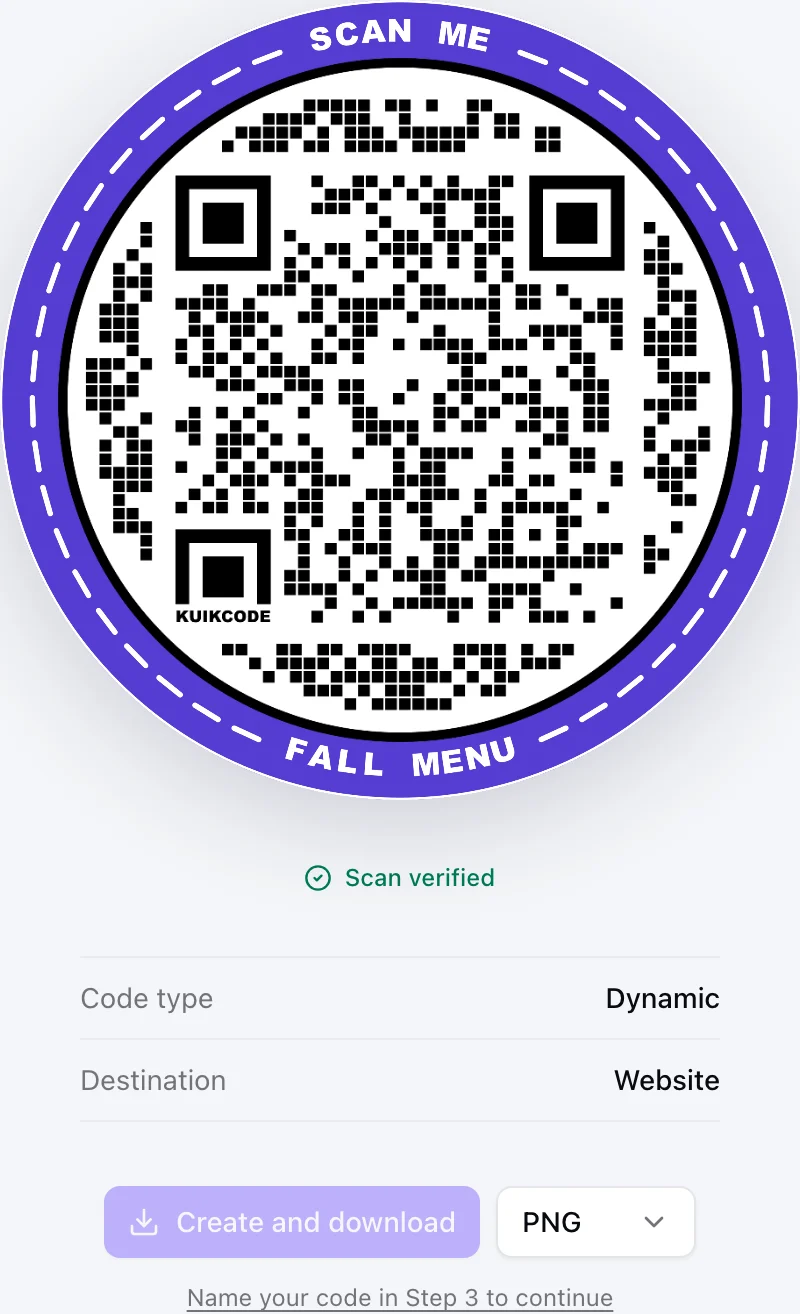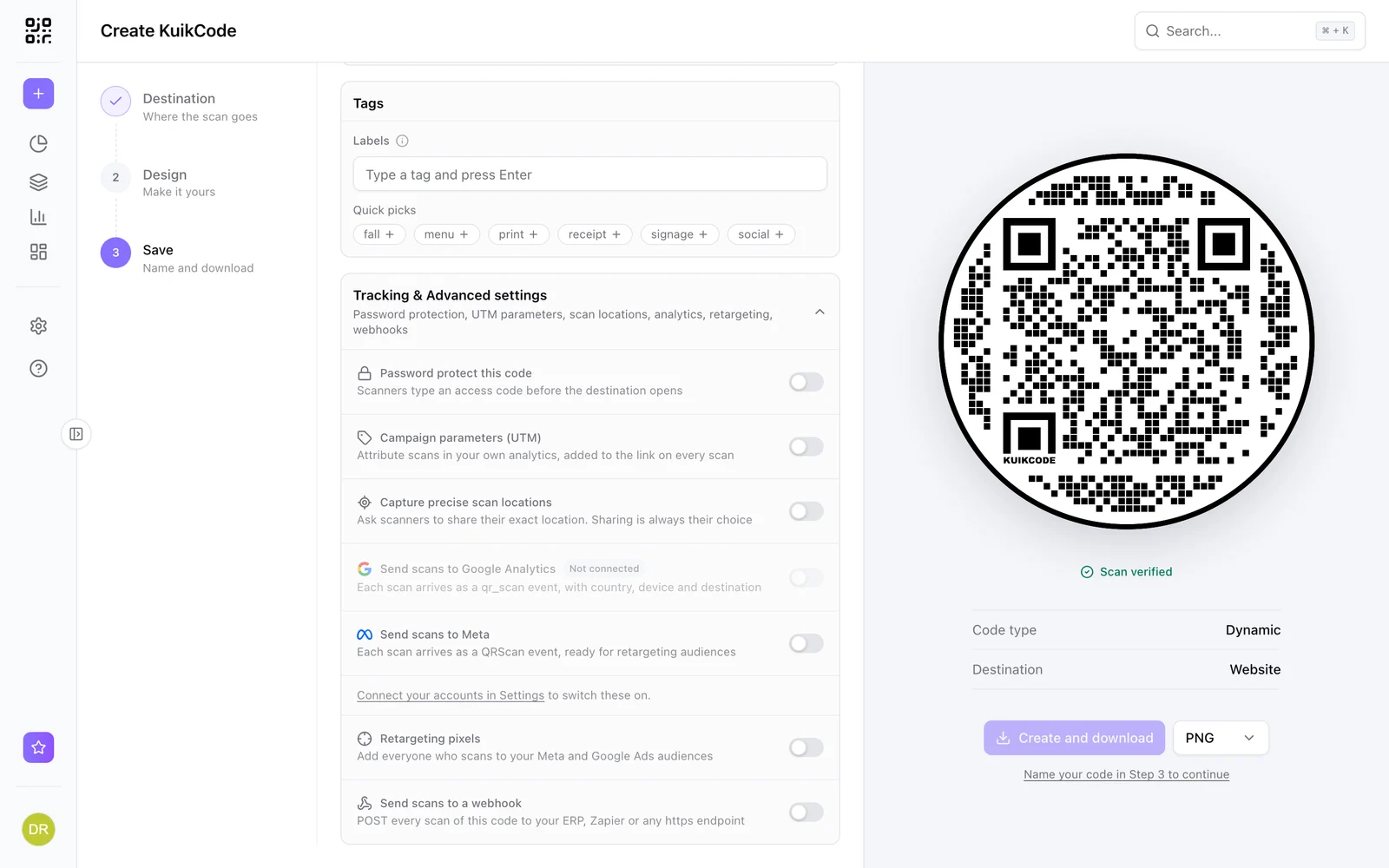
QR codes are cheap, fast and work with any phone camera. Their weak points are that people need a phone, nobody can see where a code goes before scanning, and a static code can't change once it's printed. Most of those disadvantages come from how a code is made, not from the technology, so you can avoid them before you print.
Below: every real advantage, every real disadvantage, and what to do about each one.
The advantages of QR codes
- No app needed. iPhones read QR codes with the built in camera since iOS 11, and so do most Android phones through the camera or Google Lens. People point, tap and they're there.
- Almost free to print. A code is part of the artwork you already print: a flyer, a menu, a box, a sign. A static code costs nothing; a dynamic code costs a small subscription.
- From paper to a page in one second. No typing a long address, no searching for your business. The jump from a printed piece to a website, a form, a video or a WhatsApp chat is one scan.
- Much more data than a barcode. A barcode holds a product number. A QR code holds up to 2,953 bytes: a full web address, a contact card, WiFi details or a message. More in how much data a QR code can hold and QR code vs barcode.
- Hard to break. Error correction lets a code scan even when up to 30% of it is dirty, torn or covered by a logo.
- Works from any angle. The three corner squares tell the phone where the code is and how it's rotated, so it scans upside down or tilted.
- Contactless. Menus, check-ins and payments without passing anything hand to hand.
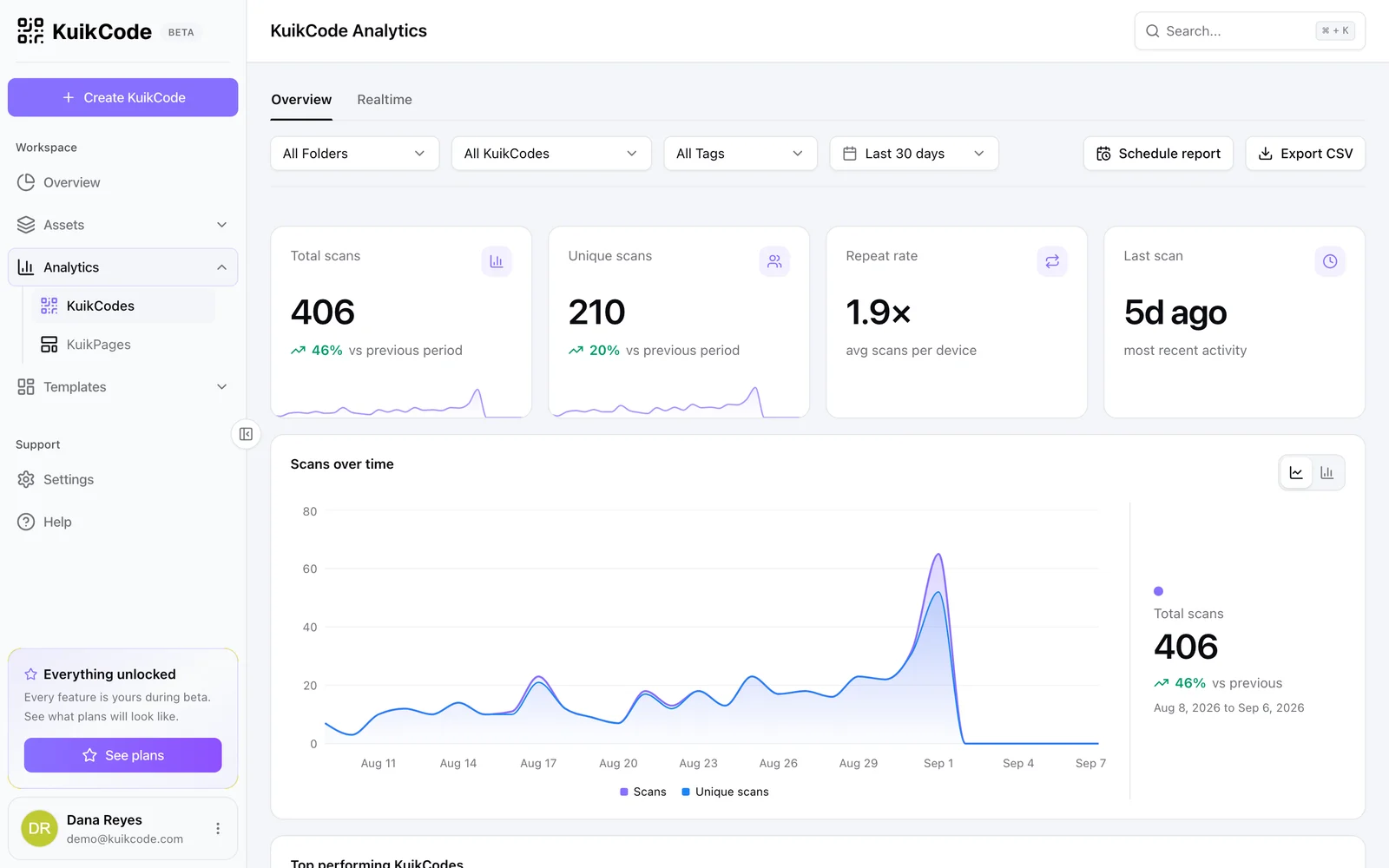
- Measurable, if dynamic. A dynamic code counts every scan with the time, city and device, so you know which flyer or table card actually works.
- Editable, if dynamic. Change where it goes after printing. A printed menu, a sign or a package can open something new every season.
The disadvantages of QR codes
- People need a smartphone, and for most content, an internet connection. Someone without a phone, or with no signal in a basement venue, can't use it.
- Not everyone scans. Many people scan every day, others never think to try, especially when nothing tells them what they'll get.
- You can't see where it goes. A QR code is unreadable to humans, which is what makes fake codes stuck over real ones possible. More in are QR codes safe.
- Bad prints don't scan. Too small, too low contrast, a missing quiet zone, a glossy reflection or a curved surface can all stop a phone from reading a code.
- Static codes can't change. The content is in the pattern. A typo, a moved page or a new phone number means reprinting every copy.
- Dynamic codes depend on a service. If the service stops, or a free trial ends, the code can stop redirecting. See do QR codes expire.
- Too much data makes a bad code. The more you store, the denser the pattern and the bigger it has to be printed.
- Privacy questions. Scan tracking can feel invasive when it's done badly. Good tools count scans without identifying people.
How to avoid each disadvantage
| Disadvantage | What to do |
|---|---|
| No phone or no signal | Print the key information or a short address next to the code |
| People don't scan | Add a clear line about what they get, like Scan for the menu |
| Can't see where it goes | Say where it leads, use a branded design and, on PRO and Business, your own domain |
| Bad prints | Print at least 2 cm (0.8 in), dark on light, with a margin, and test with two phones |
| Static codes can't change | Use a dynamic code for anything printed in quantity |
| The service might stop | Before you print, read what happens to your codes when a trial ends or you cancel |
| Too much data | Store a short link and put the content on a page |
| Privacy | Count scans, not people; tell visitors what you measure |
A code that follows those rules keeps almost every advantage and loses almost every disadvantage. The one that remains is the first: some people will never scan, so the most important information should always be readable without a phone too.
Static or dynamic: which disadvantages each one has
| Static code | Dynamic code | |
|---|---|---|
| Cost | Free | A subscription |
| Change after printing | No | Yes |
| Counts scans | No | Yes, with time, place and device |
| Pattern | Grows with the content | Always a short link, easy to scan |
| Works offline | Yes, for WiFi, text and contact cards | Needs a connection |
| Depends on a service | No | Yes |
Static codes win for fixed, private or offline content, like a WiFi password on a fridge. Dynamic codes win for everything printed for customers. The full comparison is in static vs dynamic QR codes.
Where the advantages pay off most
- Restaurant menus and table cards: a menu you can update the same day, without reprinting.
- Packaging and labels: manuals, ingredients and warranty registration on a small surface.
- Flyers, posters and ads: a page someone can act on, and a scan count per placement.
- Business cards and resumes: a contact card, a portfolio or a page with all your links.
- Events: tickets, schedules, photo sharing and WiFi.
- Shops and services: reviews, WhatsApp chats, bookings and payments.
So, are QR codes worth it?
For most printed material, yes. They cost almost nothing, they turn a passive flyer into a page someone can act on, and with a dynamic code you finally know whether print works. Just treat the code like any other part of the design: give it a reason to be scanned, print it big enough, and make sure it can change when your plans do. If you're looking for numbers on who scans and where, our QR code statistics collects them with sources.
Frequently asked questions
01What are the advantages of QR codes?+
They work with any phone camera without an app, they are almost free to print, they take people from paper to a website, menu or form in one scan, they hold much more than a barcode, they keep working when part is damaged, and dynamic codes can be changed after printing and count every scan.
02What are the disadvantages of QR codes?+
People need a smartphone and usually a data connection, some people still don't scan, nobody can see where a code leads before scanning it, small or low contrast prints fail to scan, static codes can't be edited, and a dynamic code depends on the service that runs it.
03Are QR codes safe?+
A QR code is just a link, so it is as safe as the page it opens. The risk is a fake code stuck over a real one. Phones show the address before opening it, and businesses can use their own branded domain so people recognize it.
04What is the biggest disadvantage of a QR code?+
For a printed static code, that it can never change: a typo or a moved page means reprinting everything. Dynamic QR codes remove it, because they store a short link you can point somewhere else at any time.
05What are the advantages of dynamic QR codes over static ones?+
You can change where a dynamic code goes after printing, fix mistakes without reprinting, and see how many times it was scanned, when, where and on which devices. The pattern also stays simple, because it only stores a short link.
06Do QR codes work without internet?+
The code itself is read offline by the camera. What happens next depends on the content: a WiFi password, a contact card or a text works offline, while a website or a dynamic code needs a connection.